Features
Take control of your portfolio. Operate at a new level.
Alembic is one layer over six jobs you currently do across multiple tools: reading, comparing, reconciling, remembering, grading, and tracking the portfolio itself. Here's each of them.
NVDA · Handelsblatt reads the quarter more negatively than New York
MU · data center revenue above $25B — supports link 3
Tomorrow · Broadcom reports after the close
The briefing
Written around what you own
Two or three times a day, at the times you set: what moved, what was published, what's coming — for your positions and your watchlist, not the market at large. Filings, earnings calls, fund letters, the quality press of four regions, the voices worth following on X, and any newsletters you subscribe to. Several hundred sources a day, read so you don't have to — ten minutes instead of ninety.
Listen instead of read
Every briefing is also narrated, in a voice that sounds like a person, not a GPS. Pick the length that fits the moment: a five-minute pass over the headlines, a twelve-minute standard briefing, or the full version with the reasoning behind every item. Tickers, numbers and names are read correctly, in English or German. Commute, gym, school drop-off — the briefing comes with you.
Cross-source synthesis
News, filings, earnings, fund letters and your own subscriptions, read together and reconciled into a single view. Where sources conflict, the conflict is the finding — you're shown it, not left to discover it.
Everything cited
Every claim links back to the piece it came from. Nothing is asserted without a source you can open and check yourself.
Events, before they happen
Earnings and calendar items surfaced ahead of time and framed around your positions: what to watch tomorrow, given what you're assuming.
your briefingNew York · at your times
Default chosen from your browser's time zone (America/New_York) · map centred on where you read · example figures
This morning: 47 sources, 1,284 claims, ten minutes to read.
The regional lens
Read in the original
The quality press of the US, Germany, the UK and Asia, read in its own language rather than through an English filter. Handelsblatt is read as Handelsblatt.
The same story, four desks
When a story touches something you hold, you see how each market's press is reading it — scored on Alembic's own sentiment pipeline, with the headlines side by side.
Divergence is the finding
When Frankfurt reads a story a full step more negatively than New York, that gap is surfaced and explained. Often it is the earliest sign that something has changed.
Honest about silence
A region with fewer than five articles is reported, never scored. Alembic tells you what it found; it never asserts what a market didn't cover.
Is the AI build-out losing its shine? Nvidia into its August results, read by four desks
Touches your positions NVDA and MU · Jul–Aug 2026 · headlines real and dated · scores illustrative
New York
read in English
Nvidia gave its first-ever year-ahead forecast — a 70% growth bombshell meant to silence AI bubble critics
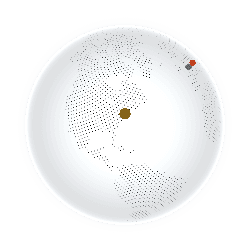
Drag the globe to look around · hover a desk to turn to it
Frankfurt (−0.55) is reading this 0.85 more negatively than New York (+0.30). That gap is what Alembic flags. It does not say which desk is right — you do.
The decision record
A case you can hold yourself to
Record why you're in: the origin of the idea, the catalysts you expect, the numbers you're assuming, and the explicit conditions that would prove you wrong. Structured, dated, and locked once written.
The case against, before you commit
Every position gets a structured counter-argument at the moment you write it up. Not to talk you out of it — to make sure you've seen the other side before you act.
Evidence, checked against your reasoning
Incoming news, filings and results are classified against your specific assumptions: supporting, contradicting, or neutral. When one of your own stated conditions breaks, that opens a review. Never an instruction.
Reviews on a schedule you set
Re-affirm, revise, or close. Quarterly, or the moment the evidence demands it. Every update is dated and appended, and the original stays visible.
Why I'm in — written at entry, then locked
- 1AI demand is accelerating.
- 2Hyperscaler capex follows, with a lag of two to three quarters.
- 3GPUs and high-bandwidth memory are the direct beneficiaries — NVIDIA on compute, Micron on memory.
- 4So: hold both while data center order books keep growing.
What proves me wrong
Hyperscalers guide capex down, or orders fall two quarters running.Locked · Mar 12, 2026
What arrived since — checked against each link
Jun 24Micron FQ3
Jun 24Micron FQ3
supporting · → link 3
Micron reports revenue of $41.5B and data center revenue above $25B; calendar-2026 HBM supply already fully contracted on price and volume — supports link 3.
Micron FQ3 2026 results, Jun 24, 2026 · FQ1 call, Dec 17, 2025
Jul 17Reuters
Jul 17Reuters
neutral · → link 2 · watch
Reuters: some investors position for slower hyperscaler spending growth; UBS sees growth slowing to 25% in 2027 — a question about link 2, not a change to it.
Reuters analysis, Jul 17, 2026
Jul 22Alphabet Q2
Jul 22Alphabet Q2
supporting · → link 2
2026 capex guidance raised again, to $195–205B.
Alphabet Q2 2026 earnings call, Jul 22, 2026
Jul 29Microsoft Q4
Jul 29Microsoft Q4
condition tested
Microsoft's calendar-2026 capex figure moves from about $190B to about $175B — looks like your condition. The transcript says it is a lease reclassification: “our calendar year 2026 CapEx investment expectations remain unchanged.” Not met.
Microsoft FY26 Q4 earnings call — Amy Hood, CFO, Jul 29, 2026 · review opened and closed
The scoreboard
Right for the right reason
When a position closes, you get a verdict on the reasoning as well as the P&L: right for the right reason, right for the wrong reason, or wrong.
Your patterns, reflected back
Over time the record shows what you can't see from the inside: which kinds of calls you get right, and where you override the conditions you wrote down.
Which of your sources is actually good
Analysts, the press, fund letters and any newsletters you follow: Alembic tracks how each source's calls played out on the names you hold — so you keep listening to the ones that earn it.
NVIDIA · opened Mar 12, 2026, closed Sep 8, 2026 · example position
So the verdict isRight, for the right reason
The four possible verdicts — and where your 26 closed positions landed
A number alone can't tell you whether you were skillful or lucky. Two questions can. Over enough closed positions, the share that lands top-left is what separates a process you can repeat from a run of luck. The NVDA figures are historical closes and cited disclosures; the position and the 26-position tally are illustrative.
The portfolio view
Every holding, in one view
Your positions across brokers, exchanges and currencies, side by side: what you hold, what you paid, its weight, and the currency it sits in.
Organized the way you think
Group positions by portfolio, theme or thesis rather than by whichever broker happens to hold them.
Linked to your reasoning
Each position carries its open decision record: the conditions you set, and whether any has been tested since you wrote it.
Read-only, like everything else
The view reflects your accounts; it cannot change them.
| Position | Weight | Since entry | Conditions |
|---|---|---|---|
| 18.5% | +23% | 1 tested | |
Decision record · Mar 12, 2026 · price since entry, with what arrived +23% since entryMar 12 · writtenJun 24Jul 29 Closes 183.14 → 225.73, Mar 12, 2026 and Sep 8, 2026 · Yahoo Finance historical data, unadjusted close “A cut to hyperscaler capex would be the thing that changes my mind.” Thesis AI capex keeps rising through 2026 Condition tested Jul 29 — lease reclassification, not met | |||
| 11.0% | +147% | 2 untested | |
| MSFT Microsoft USDNo record | 9.5% | +6% | No record |
| Holding A EUREuropean industrials2 untested | 14.0% | +4% | 2 untested |
| Holding B CHFSwiss franc bondsNo record | 22.0% | +1% | No record |
| 25.0% | −7% | 1 tested | |
Connections
Several portfolios, side by side
Hold more than one portfolio without collapsing them into a single view. Each keeps its own holdings, its own briefing scope, and its own decision record.
Multi-broker, read-only
Connect your accounts read-only. No trading permissions, no custody, no ability to move anything.
Multi-currency
Positions and performance across currencies, attributed properly rather than converted and forgotten.
Yours to take with you
Export your briefings and your decision record whenever you want. The record belongs to you.
Every connection is read-only: Alembic can see positions and transactions at your brokers and your crypto exchanges, and can never trade, move, withdraw or hold anything. Several portfolios stay separate, each in its own currencies with attribution that survives the conversion. Names shown are illustrative for the US launch.
Not on the list: telling you what to do.
Alembic surfaces evidence and organizes your reasoning. It doesn't issue buy and sell calls, it doesn't score your portfolio against a model, and it doesn't manage money. That's deliberate, and it isn't changing.
Alembic is a research and information tool. Nothing it produces is investment advice, a recommendation, or an offer to buy or sell any security, and it is not tailored to your financial situation, objectives, or risk tolerance. Alembic does not hold client assets, exercise discretion over any account, or execute transactions. All investment decisions are yours alone. Investing involves risk, including loss of principal, and past performance does not indicate future results.